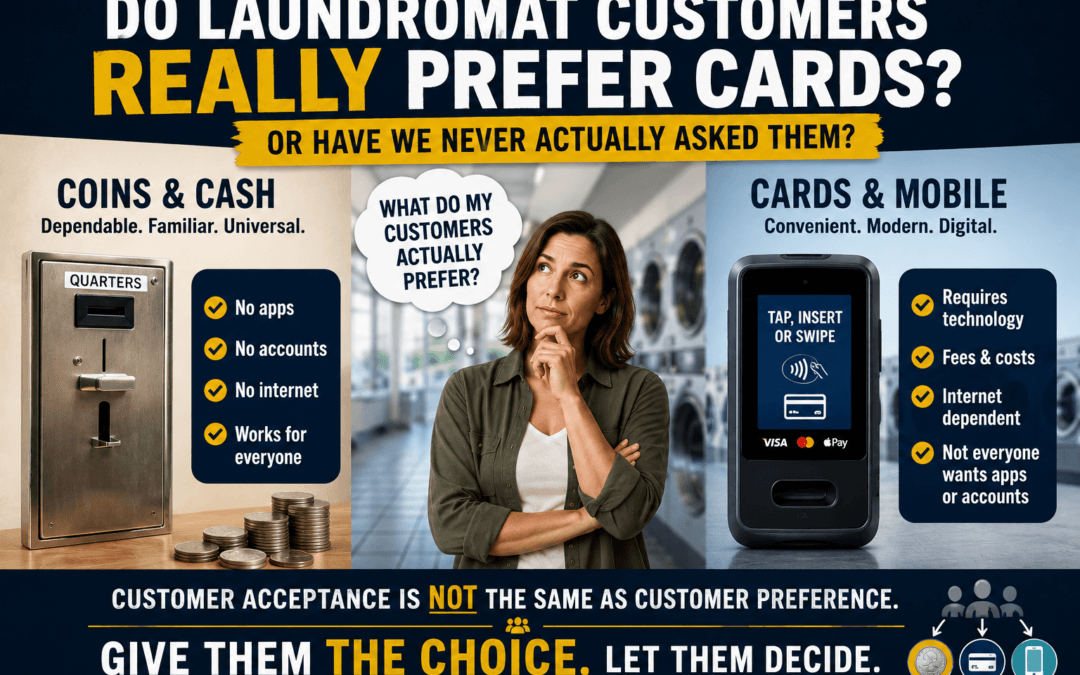
Or Have We Never Actually Asked Them?
Spend enough time on laundromat social media, and you’ll hear plenty of confident opinions about payments.
“My customers want cards.”
“Customers don’t want to carry quarters.”
“Everybody wants to pay with their phone.”
“Cash is outdated, it’s just old-fashioned.”
Maybe.
But there’s a problem with those statements:
Does anyone really know what laundromat customers prefer?
There is an important difference between what customers prefer and what they are willing to accept. And when it comes to laundromat payments, the industry often treats those two things as meaning the same thing.
They don’t.
Who Really Chooses How Customers Pay?
Walk into a card-only laundromat, and the owner has already made the payment decision for you.
You will use the stored-value card system.
Walk into an app-only store, and you’ll use the app—or you won’t do laundry there.
Walk into a coin-only laundry, and you’ll need quarters.
In each case, the owner, not the customer, has determined how the transaction will take place.
And owners have perfectly legitimate reasons for making those decisions.
A laundromat owner may want to reduce coin collections. Another wants remote management and detailed reporting. Someone else doesn’t want processing fees or dependence on internet connectivity. A new investor may simply be following the advice of an industry expert who says cashless is the future.
Those are all business considerations.
But notice whose preferences we’re talking about.
The owner’s.
Somewhere along the way, an operational decision that’s best for the owner can become a claim about what’s best for the customer.
That’s a much bigger leap.
Customer Acceptance Isn’t Customer Preference
Imagine a laundromat converts from coin to a loyalty card system.
Six months later, business is doing fine.
Customers are using the cards. Machines are running. Revenue is coming in.
The owner says:
“See? My customers like cards.”
Not necessarily.
What has actually been demonstrated is:
Enough customers are willing to use the card system to continue doing business there.
That’s valuable information—but it isn’t the same as knowing what they would choose if given multiple payment options.
The exact same argument applies to coins.
Hundreds of people successfully using quarters every week doesn’t prove they prefer quarters. It proves they’re willing to use them.
That’s why we should be careful about making sweeping claims about what today’s laundromat customer “wants.”
Don’t confuse customer acceptance with customer preference.
Multi-store owners of hybrid laundries (where they accept stored-value cards and coins at the machine) have stated that the ratio of coin vs. card usage differs by location. Some stores have a majority of customers who prefer coins, while other locations are predominantly card-usage.
But What About Customer Surveys?
Ask customers.
Sounds simple.
But even that has a problem.
Suppose a card-only laundromat surveys 200 customers and 75% say they’re satisfied with the card system.
That’s certainly useful information.
But who did we survey?
People who are already customers of a card-only laundromat.
What about the person who walked through the door, discovered that the store required purchasing or loading a laundry card, and left?
What about someone who prefers cash and chose another laundromat before ever entering yours?
What about the customer who doesn’t particularly like the card but uses it because your laundry is clean, safe, and two blocks from home?
They’re much harder to measure.
The same bias can exist at a coin-only store. Its existing customers are, by definition, people who are willing to use coins.
This is why anecdotal statements like “My customers love it” should be treated carefully regardless of the payment technology being discussed.
Maybe they do.
But how do you know?
The Decision Is Usually About What’s Best for the Owner
Listen closely to many discussions about laundromat payment systems, and you’ll notice something interesting.
The strongest selling points frequently aren’t customer benefits at all.
They’re owner benefits.
“You’ll never have to collect quarters again.”
That’s an owner benefit.
“You can manage your store remotely.”
Owner benefit.
“You’ll get detailed transaction reporting.”
Owner benefit.
“You can change vend prices remotely.”
Owner benefit.
Those may be terrific reasons to invest in a payment system. Operational efficiency matters.
But we shouldn’t automatically convert those benefits into:
“This is what your customers want.”
Maybe customers love the system too.
Maybe they don’t care.
Maybe some prefer it, and others don’t.
And maybe payment preferences vary dramatically by neighborhood, age, income, banking habits, and individual customer.
That’s exactly the point.
We shouldn’t pretend to know something we haven’t adequately measured.
Every Payment Method Has Trade-Offs
Coins aren’t perfect.
They must be collected, counted, transported, and replenished. Coin mechanisms require maintenance. Change machines need to be kept filled.
Card systems solve some of those problems.
But they introduce others: equipment costs, processing or service fees, proprietary hardware, networking requirements and technology that eventually needs replacement.
Mobile payment can provide tremendous convenience for customers who want it.
But not everybody wants another app, another account or another password just to wash a load of clothes. And there have been reports of “QR Code Hijacking” recently, where criminals cover your QR code with their own sticker to get credit card information.
No payment technology is without trade-offs.
That makes it hard to support the idea that one payment system is universally “best” for every laundromat and every customer.
What If You Let the Customer Decide?
There is another approach.
Instead of trying to determine whether customers prefer cash or electronic payment, why not let them choose?
A customer who wants to tap a card or use a phone can do so.
A customer who walked in with a $20 bill can turn it into quarters.
A regular customer can use whichever method is most convenient that day.
And the owner doesn’t have to predict what every customer wants.
The customer tells you—by choosing.
That may provide more meaningful information than any survey.
If customers consistently have multiple payment methods available, their transactions show what they prefer when given the choice.
Multi-store owners of hybrid laundries (where they accept stored-value cards and coins at the machine) have stated that the ratio of coin vs. card usage differs by location. Some stores have customers who prefer coins, while other locations are predominantly card-based.
Before You “Ditch Quarters,” Ask a Different Question
The laundry industry spends a lot of time debating:
Coin or card?
Maybe that’s the wrong question.
Before removing a payment option that customers already use, perhaps owners and investors should ask:
What do I gain by eliminating this choice for my customers?
Reducing coin collection may absolutely be worth it for some stores.
A loyalty card system may be an excellent investment for another.
Mobile payment may make perfect sense for a particular customer base.
And coins may remain an important part of the payment mix somewhere else.
But those decisions should be based on the economics (does the math work?), operating realities, and actual customers of an individual laundromat—not simply because someone on social media declared one payment technology the future of the industry.
Your Customers May Know the Answer Better Than We Do
There’s nothing wrong with innovation.
There’s also nothing wrong with technology that has worked reliably for decades.
The objective isn’t to defend coins, cards, or mobile payments.
The objective is to make it as easy as possible for customers to pay you!
And until the industry has broad, reliable research measuring what laundromat customers would actually choose when presented with multiple payment options, we should be cautious about claiming we know what they “want.”
We know what they’ll accept.
We know what laundromat owners choose to install.
Those aren’t necessarily the same thing as customer preference.
So perhaps the smartest payment strategy isn’t choosing for them.
Give customers choices. Let them decide how they want to pay.
Because the best payment method may not be the one an influencer, equipment supplier—or even the laundromat owner—prefers.
It may simply be the one the customer standing in front of the washer wants to use today.