Your Brand Is More Than Just A Good Logo
Branding.
It’s become one of the favorite “catchwords” in the laundromat industry. Build your brand!
Create a memorable name. Develop a great logo. Pick distinctive colors. Design beautiful signage. Build a website. Create a social media presence. Make your laundromat stand out from the competition.
None of that is wrong. A professional appearance matters. A recognizable identity can help customers remember your business. Good signage can make a store easier to find. Consistent colors, uniformity, and graphics can make a laundromat feel more professional.
But let’s not confuse branding a laundromat with operating a great laundromat.
They’re not the same thing.
What Is Your Customer Looking For?
Most people aren’t driving through town hoping to discover a laundromat with an incredibly clever name. They’re looking for something much simpler:
COIN LAUNDRY.
LAUNDROMAT.
LAVANDERIA.
Once they find you, the questions become even more basic.
- Can I park?
- Does this place look safe?
- Is it well lit?
- Is it clean?
- Are there enough machines?
- Do the machines work?
- Is the restroom clean?
- Can I get help if something goes wrong?
- Can I pay in a way that’s convenient for me?
And perhaps most importantly:
Do I want to come back here next week?
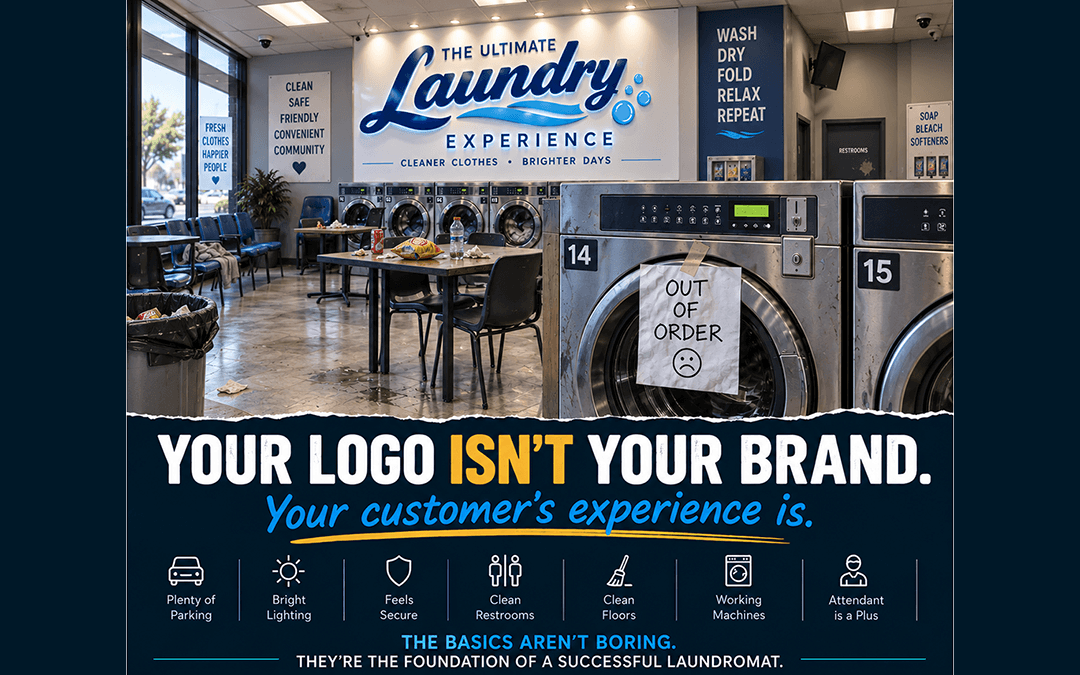
Your logo can help get someone through the door the first time. The experience determines whether they return.
Your Brand Isn’t Just Your Logo
We’ve probably all seen businesses with terrific names, beautiful logos, coordinated color schemes, and expensive signs that are no longer in business.
Why?
Because a logo isn’t a business model. And it’s not the most important aspect of your brand, either. Your brand is what customers come to expect when they walk through your door. In the old days, we called it the “Customer Experience.”
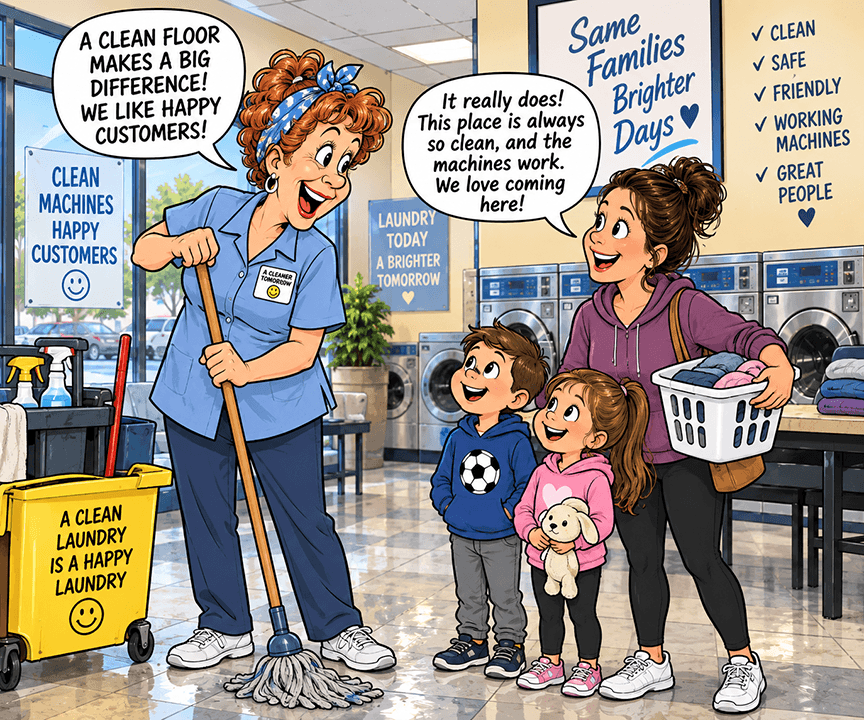
If the floors are consistently clean, that’s part of your brand (customer experience).
If almost every washer and dryer is working, that’s part of your brand (customer experience).
If the store is bright and feels secure at night, that’s part of your brand (you got it now).
If someone cleans the restroom regularly, that’s part of your brand.
If an attendant greets customers and helps when there’s a problem, that’s part of your brand.
If the change machine works when someone inserts a $20 bill, that’s part of your brand.
If customers know they can reliably get their laundry finished without aggravation, that’s your brand.
The logo is simply the picture they associate with that experience. A brand is meant to elicit a feeling associated with the name – based on your customer experience, things you read or heard.
When you hear “Nike,” you have an opinion about that brand, good or bad, but you have a reaction to that brand. Same with Coca-Cola, Amazon, Tide, and even Standard Change-Makers!
The Boring Stuff Isn’t Very Exciting
Here’s the problem. Nobody wants to attend an industry seminar titled:
“Keep Your Restroom Clean and Fix Broken Washers.”
It isn’t particularly exciting.
Neither is:
Sweep the floor several times per day.
Empty the trash as needed.
Keep the lights in working order.
Clean the lint traps and drains.
Maintain the Washers and Dryers.
Answer customer complaints promptly.
Keep the parking lot clean.
Make sure customers feel safe.
Have enough change available.
None of those ideas are revolutionary. They’re boring. They’re also remarkably important!
And unlike new technology, marketing programs, or business trends, you have to do them every single day.
We Love the Next Big Thing
Every industry has its trends, and commercial laundry is no different.
Today it might be Wash-Dry-Fold. Then Pickup and Delivery. Then loyalty programs. Then apps, sophisticated card systems, incremental “penny” pricing, promotional revalues designed to encourage customers to return.
Tomorrow it will be something else.
Some of these ideas can create real opportunities and generate additional revenue. And then a couple of these concepts may open an entirely different customer segment.
Electronic payments can provide convenience, reporting, and pricing flexibility.
Loyalty programs can encourage repeat business.
There’s nothing inherently wrong with any of them.
But none of them fixes a bad laundromat or a business plan based on a great logo design.
A jammed coin drop doesn’t clean the dirty floors.
A loyalty card doesn’t fix an out-of-order washer.
Penny-increment pricing doesn’t make a dark parking lot feel safer.
A mobile app can’t clean a restroom.
And giving customers bonus value won’t create loyalty if they don’t enjoy being in your store in the first place.
Can You Buy Loyalty?
That last point deserves some thought.
Stored-value systems sometimes encourage owners to use bonus revalues to build customer loyalty:
- Load $20 and receive additional $2 value.
- Come back on Tuesday and earn a bonus.
- Spend more and receive rewards.
Those can certainly be effective promotions.
But are they actually creating loyalty? Or are they purchasing another visit?
There’s a difference!
True loyalty may be much less complicated.
A customer knows your machines work, your store is clean, they feel comfortable bringing their children, there’s always a parking spot available, the attendant knows them by name, and if something goes wrong – somebody makes it right.
They can get in, do their laundry, and get on with their day.
That’s loyalty you don’t have to buy.
Don’t Mistake Complexity for Improvement
Business owners naturally look for ways to grow.
That’s healthy.
But sometimes we become so interested in the newest way to increase revenue that we overlook the easiest way to protect the revenue we already have:
Run the business exceptionally well.
Before adding another service, ask whether the existing operation is excellent.
Before spending money on a rebranding campaign, walk through the store like a first-time customer.
Look at the parking lot.
Look at the entrance.
Look behind the washers.
Check the restroom.
Count the out-of-order signs.
Look at the ceiling lights.
Sit in the customer seating area for twenty minutes.
Try the change machine.
Use the payment system.
Talk to the attendant.
Then ask yourself:
Would I come back?
The Basics Are the Brand
None of this means branding doesn’t matter.
It does.
A strong name, professional logo, attractive colors, good signage, and consistent marketing can help distinguish one business from another.
But those things should represent something.
They should represent a laundromat that delivers what customers actually need.
Clean.
Bright.
Safe.
Reliable.
Convenient.
Friendly.
Well-maintained.
You can spend thousands of dollars creating a beautiful brand identity. But customers ultimately build your reputation. They create it every time they walk through the door. And they reinforce it every time they decide whether to return.
So, by all means, create a great logo. Put up that beautiful sign. Build a website.
Offer WDF if it makes sense. Explore PUD. Accept different forms of payment.
Use technology where it improves the customer experience or makes your operation better.
But don’t become so distracted by the next big thing that you neglect all the little things.
Because after all the industry trends, technology, and marketing terminology are stripped away, successful laundromat ownership still comes down to some remarkably unexciting things:
Keep it clean.
Keep it safe.
Keep the machines working.
Take care of your customers.
Do it again tomorrow.
The boring basics aren’t separate from your brand. They are your brand.
The customer experience is your brand.