Key Takeaways
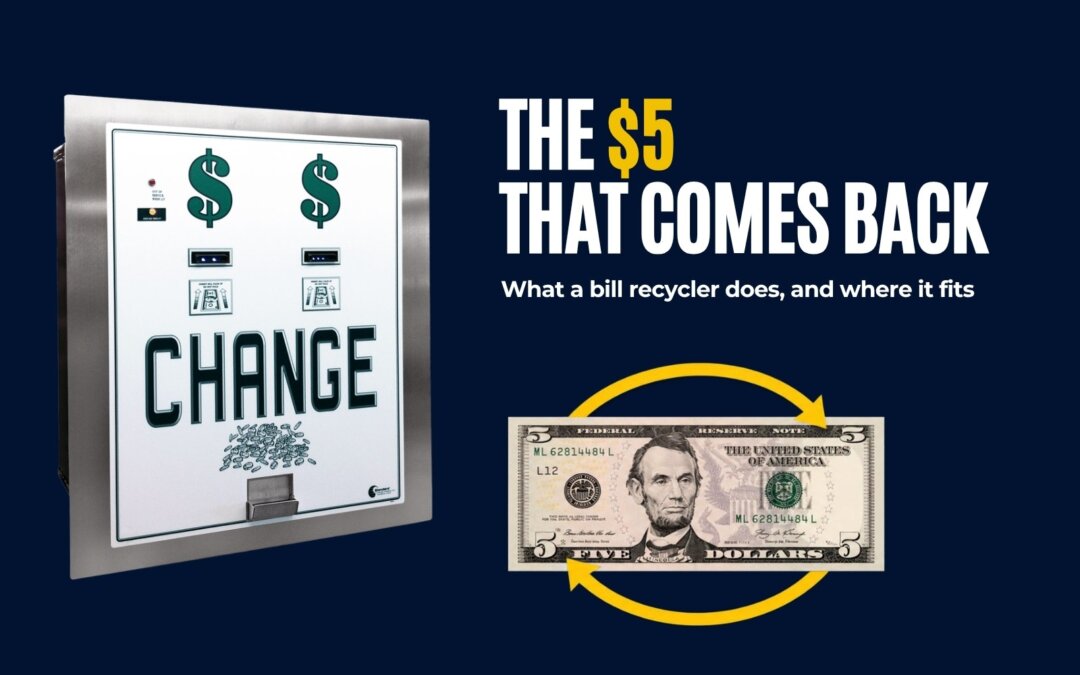
A bill recycler is a type of bill validator that accepts $5 bills from customers and re-dispenses those same bills as change for subsequent transactions. Rather than drawing from a pre-loaded coin hopper alone, these machines route accepted bills into an internal holding barrel, where they are stored until needed as change. Bill recyclers are frequently used in unattended locations, including laundromats, car washes, and vending operations, where the cost of high-volume bill dispensing creates a recurring operational, security, or financial burden.
If you run an unattended laundromat or car wash, you already know what a hopper running dry in the middle of the week costs you.
A bill recycler (also called a bill recycling acceptor or note recycler) is a type of change machine that accepts bills, holds them internally in a storage barrel, and re-dispenses those same bills as change when a customer inserts a larger denomination bill. The business’s traffic is expected to keep the recycler replenished throughout the day, which cuts down on how often you need to make a manual reload trip. It also allows the coin supply to last longer.
The question most operators want answered is whether this is different enough from a standard change machine to matter for their location. The answer depends on how your location actually runs.
How Does a Bill Recycler Work?
The key is the recycler barrel. Attached to the bill validator, a bill recycler unit holds up to 25–30 bills. When a customer inserts a $20 bill, the machine can return a mix of coins and bills: twenty quarters from the coin hoppers and three $5 bills from the barrel, dispensed one at a time from the bill acceptor bezel. This combination is what allows the machine to function as a low-volume bill-and-coin exchanger rather than a coin-only change machine.
The self-replenishing mechanic is what sets it apart. When other customers insert their own $5 bills to get quarters, those bills go back into the barrel. You load the machine at the start of the week; your customers help keep it stocked throughout the day. When one barrel runs low, the machine automatically transfers dispensing to the second bill recycler unit. When both recycler barrels are empty, a “COINS ONLY” indicator light alerts customers that they’ll receive coin change only.
Who Benefits from a Bill Recycler?
The operators who get the most from a bill recycler are the ones running unattended locations where the owner wants to provide the convenience of a combination of bills with coin change. The combination payout allows the coin supply to last longer, with minimal upfront investment in $5 bills.
Laundromats are the clearest fit. There are approximately 29,500 coin laundries operating in the United States, according to the CLA (formerly the Coin Laundry Association), and many are independently-owned with no full-time staff on-site. Managing cash collection, equipment checks, and restocking is part of the weekly routine for any owner running the location alone, as the WashBizHub Laundromat Operations Guide documents. Busy washdays, particularly weekends, generate concentrated change demand in a short window; a machine that extends the time between reload trips has a direct effect on how that week gets spent.
Car wash operators know the same problem from a different angle. Bays running on quarters drain fast on a Saturday morning, and the choice is either staffing the location during peak hours or showing up for an unscheduled reload. A bill recycler extends the interval between those trips, not indefinitely, but enough that the pattern becomes manageable.
The benefit narrows for lower-volume locations. If your customers aren’t cycling enough $5 bills through the machine to keep the recycler barrels stocked, the self-replenishing mechanic doesn’t kick in consistently, and you’re reloading on a schedule anyway.
Bill Recycler vs. Standard Change Machine: Which One Do You Need?
For many locations, standard change machines are still the right answer. If your change demand is moderate and your reload schedule is manageable, a machine with a well-sized coin hopper and a solid bill acceptor handles the job without added complexity. Reloading on a regular schedule works fine when the hopper lasts between service visits without running dry.
The case for a bill recycler is specific. It makes sense when reloading has shifted from a scheduled task to a recurring disruption: when you’re making extra trips specifically because the coin hopper runs dry before your service day, or when weekend peak hours create a pattern of mid-day out-of-coin complaints. For locations where that’s already happening, a bill recycler can assist in handling higher transaction volume and help reduce both the trips and the downtime.
Here’s a practical self-test: how often is your change machine’s coin supply the reason you need to be on-site unscheduled? If the answer is rarely, a standard coin machine likely fits. If it happens frequently, a bill recycler is worth investigating.
Service and Long-Term Value
For any unattended, self-service business, buying a change machine and buying the service support behind it aren’t really separate decisions.
At Standard Change-Makers, we’ve built currency change machines for laundromats, car washes, and vending operations since 1955. Our bill recyclers are built to the same standard: modular components, field-serviceable, with parts sourced from the manufacturer that designed them. When something needs attention, a technician can work on the component without pulling the entire unit. The machine stays in place, and the repair is targeted.
We still carry parts for machines that have been running since the 1990s. For an operator running an unattended location, the difference between a manufacturer who stocks those parts and one who doesn’t is the difference between a same-week repair and a machine sitting dark.
Frequently Asked Questions
Do laundromat customers replenish the recycler barrels on their own?
Yes: customers who insert $5 bills to get quarters are actively restocking the recycler barrel throughout the day. In high-traffic locations, this cycle keeps the machine running longer between manual reloads. In lower-traffic settings, customer bill volume may not be consistent enough to sustain the replenishment cycle adequately.
Is a bill recycler the right choice for a smaller or lower-volume location?
A standard change machine is usually the better fit for lower-volume locations. The self-replenishing mechanic works best when enough customers are cycling $5 bills through the machine each day to keep the recycler barrels stocked. If your location doesn’t generate consistent bill traffic at that level, the bill recycler’s main advantage (reduced reload frequency) won’t show up clearly.
What happens when both recycler barrels in the machine run empty?
When both recycler barrels are empty, a “COINS ONLY” indicator light on the machine lets customers know they’ll receive coin change only, not bills. The machine continues to operate for coin-only transactions. You’ll need to reload the recycler barrels with bills on your next service visit to restore full bill-and-coin dispensing.
Does a bill recycler replace a coin hopper, or does it work alongside one?
A bill recycler works alongside the coin hoppers, not in place of them. The coin hoppers continue to dispense quarters; the bill recycler handles the bill portion of the transaction. When a customer inserts a $20 bill, the machine can dispense coins from the hopper and bills from the recycler barrel in the same transaction.
Contact Standard Change-Makers to find the right machine for your location.