What You Need to Know
A currency change machine accepts paper bills and returns coins, tokens, tickets, or smaller denominations. No staff required. Also called bill changers or coin changers, these machines are core infrastructure for laundromats, car washes, and vending operations, not optional accessories. This article covers how they work, which type fits your location, and what to evaluate before you buy.
Running a self-service location without a change machine is a gamble most operators eventually stop taking. Whether you run a laundromat, a car wash, an amusement attraction, or a vending route, customers need a simple way to get the coins or bills your equipment requires. When they cannot get change, the transaction does not happen, and neither does the return visit.
Currency change machines solve a straightforward problem: they give customers the change they need to complete a transaction, every time, without anyone behind a counter. They also take cash handling off your employees’ plates at locations that do keep staff on site. Here is what you need to know before choosing one.
What a Currency Change Machine Does
A currency change machine accepts a paper bill, validates it, and returns the correct value in coins, tokens, tickets, smaller bills, or a combination. The customer inserts a bill. The machine authenticates it, stores it securely, and dispenses the programmed amount of change. The whole exchange takes a few seconds and requires no assistance from an attendant.
That last part matters more than it might seem. Many laundromats, car washes, amusement facilities, and vending locations operate unattended for part or all of the day. When a customer needs change, the machine becomes the employee. It keeps transactions moving and revenue coming in when no one is there to make change manually.
The component doing the heaviest work is the bill validator. It scans each bill against a series of security features to determine whether it is genuine. Pass, and the validator accepts and stores the bill. Fail, and the bill comes back to the customer. Validator quality matters on both ends: it prevents counterfeit acceptance, and it keeps legitimate bills from being rejected, the most common source of customer frustration in busy locations.
Once a bill is accepted, the machine’s controller signals the coin hoppers, bill dispensers, or token dispensers responsible for the payout. Modern machines also include a redundancy feature the industry calls making best change: if one dispenser cannot complete its assigned payout, the machine completes the transaction with an alternate combination instead of failing it.
Types of Currency Change Machines
The right machine depends on what your customers need to walk away with. Most locations are served by one of three core types, plus a close cousin.
Bill Exchangers
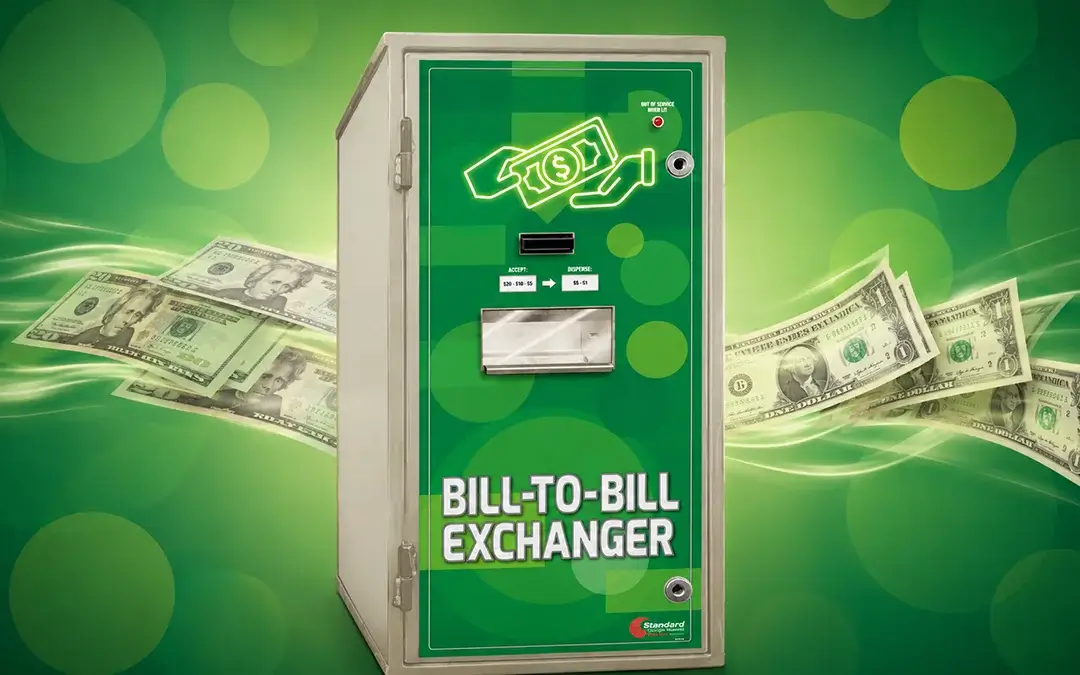
Bill exchangers accept a larger bill and return smaller bills. They fit businesses where customers need spending flexibility rather than coins. A customer with a $20 bill may only need a $5 to add value to a loyalty card or cover a small cash purchase. The exchanger handles it automatically instead of pulling an employee away to make change.
Coin Dispensers
Coin dispensers accept paper currency and return quarters, dollar coins, tokens, or a mix. These are the workhorses of the self-service industry, the standard choice for laundromats and self-service car washes where quarters drive nearly every transaction. A customer who cannot get quarters will not run a wash cycle, full stop.
Multi-Function Change Machines
Multi-function machines combine bill exchange and coin dispensing in a single cabinet. Depending on configuration, they dispense smaller bills, coins, tokens, or multiple payout combinations. They suit larger facilities and mixed-use locations serving customers with different payment needs, and they reduce the number of machines an operator has to buy, stock, and service.
Pay Stations
Pay stations are not change machines in the strict sense, but they sit in the same family, most common at automatic bay car washes. A pay station can accept cash, cards, loyalty codes, or promotional codes, activate equipment, and in some configurations dispense change or tokens. Payment processing and equipment activation live in one unit, which simplifies the site for customers and owners alike.
Operations that run on tickets rather than coins or tokens have a dedicated option as well: ticket machines.
Who Needs a Currency Change Machine?
The honest answer: any business where customers need coins, tokens, or smaller bills to complete a transaction, and no one is there to make change.
For laundromat owners, this is not a close call. A customer who cannot get the coins to start a washer or dryer is a lost sale right now, and more importantly, a customer deciding where to do laundry next week. That is not a customer complaint. It is a lost retention opportunity that compounds over time. A reliable change machine removes that friction entirely.
Self-service car washes face the same dynamic. Customers arrive expecting to wash a vehicle, not hunt for quarters. If a wash bay will not activate, many will drive to a competitor, and one machine out of service during a busy weekend can redirect a meaningful number of them. Even a short disruption in change availability shows up in revenue.
Vending operators deal with a slightly different version of the same problem. When customers cannot complete a transaction because they lack the right change, they leave, and many do not come back. A change machine next to the vending bank saves the sale and the repeat visit.
Change machines are also standard equipment at amusement centers, arcades, campgrounds, transit facilities, and event venues, anywhere customers pay with coins, tokens, or cash.
The common thread is unattended operation. If your business runs without staff for any part of the day, a currency change machine is part of the infrastructure that keeps it functional. Staffed locations use them too, to cut labor demands and keep lines moving at peak.
What to Look for When Choosing a Currency Change Machine
Price is often the first thing operators compare, but it should rarely be the deciding factor. A currency change machine is a revenue-generating piece of equipment. The real question is not what it costs to buy, but how reliably it will perform over the next ten or twenty years.
Bill Validator Performance
The bill validator is the first component every customer interacts with. If it rejects legitimate bills, customers get frustrated and transactions slow down. Look for a validator that accurately identifies genuine currency, rejects counterfeits, and holds up under daily high-volume use. Frequent rejections are one of the most common causes of complaints and service calls.
Capacity and Refill Frequency
Every machine has a finite payout capacity, whether it dispenses coins, tokens, or smaller bills. A machine that runs out of quarters at 2 p.m. on a Saturday is functionally useless for the rest of the day. Weigh your daily transaction volume, your busiest windows, and how often you want to collect from equipment and replenish the changer. Larger hoppers, or a second machine, can cut refill trips significantly and prevent shortages.
Security Features
Change machines hold large amounts of cash, often in unattended locations. Strong cabinet construction, high-security locks, protected cash boxes, and anti-stringing measures protect both the machine and its contents. Evaluate security as carefully as dispensing performance, especially for sites that run around the clock.
Reliability and Serviceability
Even the best equipment eventually needs maintenance. When that happens, parts availability and service support separate a manageable breakdown from a prolonged outage. For an unattended location, every hour of downtime is lost revenue. Before purchasing, ask how long replacement parts stay available and whether the manufacturer answers the phone with someone who knows the machine.
Build Quality and Long-Term Durability
Self-service businesses are hard on equipment. Change machines live in public spaces, get used all day, and are often exposed to humidity, dust, and temperature swings. Heavy-duty construction and proven components mean longer service life and lower total cost of ownership. Standard Change-Makers has built currency change machines since 1955, engineering them for the transaction demands of self-service locations rather than adapting general-purpose hardware.
Frequently Asked Questions About Currency Change Machines
How does a currency change machine work?
A customer inserts a bill. The bill validator reads and authenticates it. Once accepted, the machine dispenses the correct change, whether coins, tokens, or smaller bills, and the transaction closes. No staff involvement is required at any point in that process.
What is the difference between a bill exchanger and a coin dispenser?
A bill exchanger takes a larger bill and returns smaller bills. A coin dispenser takes a bill and returns coins. Laundromats and car washes typically need coin dispensers because quarters drive most of their transactions. Locations with more varied customer needs may benefit from a bill exchanger or a multi-function unit that handles both.
How long do currency change machines last?
Service life depends on build quality, transaction volume, and the consistency with which the machine is maintained. Machines built for commercial, high-traffic use and supported by a manufacturer with available parts will outlast general-purpose alternatives. Before purchasing, ask specifically about parts availability and service response time. Those two factors shape the realistic lifespan of any machine in a demanding environment.
Are currency change machines a good investment for a small operation?
For any unattended location where customers need change to complete a transaction, yes. Even a single machine that eliminates change-related friction at a small laundromat or car wash reduces abandoned transactions and keeps customers from developing the habit of going elsewhere. The operational case gets stronger as transaction volume increases, but it holds at a smaller scale too.
Reliability Is What Keeps Customers Coming Back
An unreliable change machine does not just frustrate customers at the moment. It trains them to stop counting on your location. Standard Change-Makers engineers currency change machines specifically for the demands of unattended operations, backed by service support and parts availability that keep downtime short when it matters most.
Contact Standard Change-Makers to find the right machine for your location.