
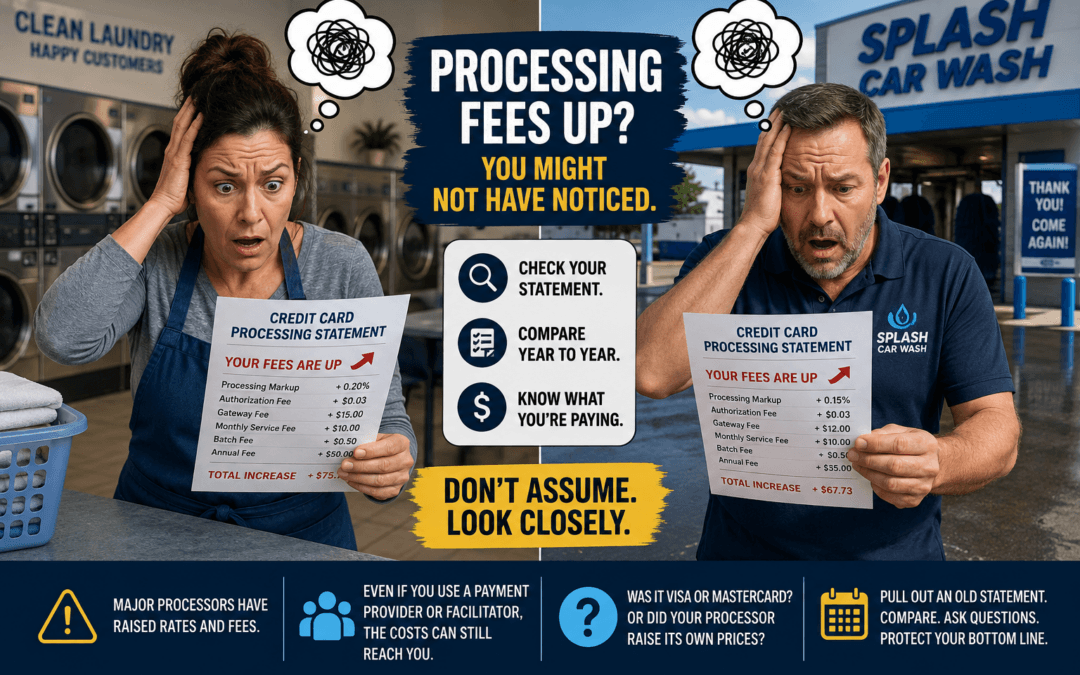
Major payment processors have been raising rates and fees. Even if you don’t recognize their names on your statement, those higher costs can eventually work their way down to you.
If your business accepts credit or debit cards, pull out your latest processing statement. Then find one from a year ago.
Put them side by side.
Major payment processors have recently announced increases involving processing markups, per-transaction charges, authorization fees, monthly fees and other merchant costs.
Some increases are small. Some aren’t.
And the “announcement” may have been nothing more than a notice on a statement or electronic communication that was easy to overlook.
Your rates could have changed without you realizing how much you’re now paying.
And don’t stop reading because you don’t see the name of your payment provider below.
You may use Square, PayJunction, a laundry card system, a car wash payment system, a vending payment provider, or another integrated payment company. Behind those familiar names can be a much larger network of processors, acquiring banks, and card networks.
When costs increase somewhere in that chain, the effects will eventually reach the merchant.
The Big Processors Have Been Raising Fees
Recent industry reports have documented processing increases involving some of the largest names in payments.
Fiserv/First Data reportedly increased pricing for affected merchants in July 2026, including an additional 5 basis points on interchange-plus card volume and another $0.03 per authorization. Some merchants on tiered pricing reportedly received larger increases.
Global Payments reportedly implemented a 20-basis-point increase for affected merchants beginning in January 2026. Other notices have identified changes involving discount rates, authorization fees, and per-item charges.
TSYS, owned by Global Payments, reportedly implemented significantly larger increases on certain merchant accounts during 2025.
Heartland, also owned by Global Payments, has reportedly notified merchants of processing-fee increases and assessed additional service and annual fees.
Elavon reportedly implemented increases in February 2026 involving basis points, per-transaction charges, batch fees and other costs.
Worldpay has also reportedly increased pricing affecting certain transaction categories and account charges.
Not every merchant received every increase. Pricing varies by processor, contract and merchant.
But the trend should get the attention of anyone accepting electronic payments.
“But I Don’t Use Any of Those Companies.”
Maybe not directly.
That’s where credit card processing gets confusing.
The company you know may be a payment facilitator, gateway, ISO, software provider, or integrated payment system that relies on other companies to help complete your transactions.
A simplified transaction might look something like this:
Customer → Your Payment System → Payment Provider/Facilitator → Processor/Acquiring Bank → Card Network
The actual relationships can be considerably more complicated.
So the name on your terminal, app, or monthly invoice doesn’t necessarily tell you every company involved in processing the transaction.
If underlying processing costs increase, your payment provider has choices. It might absorb the increase for a while. It might renegotiate its costs. Or eventually it may adjust its own pricing.
That could mean a higher percentage, another few cents per transaction, an increased gateway or platform charge, a new monthly fee or another change somewhere in the pricing structure.
You aren’t necessarily insulated from rising processing costs simply because you don’t recognize the big processor’s name.
A Few Basis Points Can Become Real Money
Processors frequently describe percentage changes in basis points.
One basis point is 0.01%.
Sounds insignificant.
But:
10 basis points = 0.10%
20 basis points = 0.20%
50 basis points = 0.50%
An additional 0.50% on $500,000 in annual card sales is $2,500 per year.
On $1 million, it’s $5,000.
Now add another few cents per transaction, a higher monthly service charge, an annual fee or another assessment.
Small changes don’t necessarily stay small.
Who Actually Raised Your Rate?
This may be the most important question in this article.
When your processing costs increase, don’t automatically assume Visa or Mastercard raised them.
There are several layers of costs involved in accepting a card.
Visa, Mastercard, Discover and American Express establish various interchange, network and assessment charges.
Those costs can change, and processors may legitimately pass those increases through to merchants.
But processors and payment providers also charge their own markups and fees.
Those can change, too.
So when you see an increase, ask:
Was this a card-network/interchange increase—or did my processor or payment provider increase its own price?
Those are not the same thing.
Ask your provider to explain the increase.
Better yet, ask for the explanation in writing.
The Increase May Already Be on Your Statement
Don’t expect a phone call saying:
“We’re raising your processing rate next month.”
Depending on your agreement, notification may come through a statement message, email, electronic portal or another permitted communication.
Then the new pricing takes effect.
Five basis points here.
Another nickel or dime per transaction there.
A monthly fee increases.
A new annual charge appears.
The merchant keeps accepting cards, the money keeps reaching the bank account, and business continues as usual.
Unless somebody is actually comparing statements, the additional cost can blend into the background.
Integrated Payment Systems Deserve Extra Attention
This is especially important for businesses using payment systems integrated with their equipment or operating software.
Laundromats, car washes, vending operations and amusement businesses increasingly use systems combining payment acceptance with loyalty programs, stored-value accounts, remote management, reporting and other services.
Those features can provide real benefits.
But integration can also make changing payment providers more complicated.
If switching processors also means replacing readers, changing software, migrating customer accounts or altering other equipment, a merchant may have less flexibility to shop for a better processing rate.
That makes understanding the pricing agreement—and monitoring changes to it—even more important.
Before choosing an integrated system, ask:
Who actually processes the transactions?
Can I choose another processor?
Which fees can the payment provider change?
What happens if its underlying processing costs increase?
What would it cost me to switch providers later?
Those questions may ultimately matter as much as the processing rate you’re quoted today.
Do This Today: The 10-Minute Processing Checkup
Find your newest processing statement and one from 12 months ago.
Compare:
- Processing or discount markup
- Per-transaction charges
- Authorization fees
- Gateway or platform fees
- Monthly service charges
- PCI/compliance fees
- Batch charges
- Non-qualified surcharges
- Annual fees
- Any charge you don’t recognize
Then calculate:
Total processing fees ÷ total card sales = effective processing cost
That number can naturally fluctuate because of card mix, rewards cards, transaction methods, and other factors.
But if it has changed significantly, find out why.
And don’t stop at:
“Processing costs went up.”
Ask which processing costs went up—and who raised them.
Payment Choice Still Matters
At Standard Change-Makers, we manufacture equipment for businesses where relatively small transactions are common—laundromats, car washes, vending locations, amusement businesses and other unattended operations.
We recognize the convenience electronic payments provide. For many businesses and many customers, accepting cards makes sense.
But convenience has a cost.
And unlike electronic transactions, a quarter doesn’t suddenly cost another five basis points to accept.
That’s one reason we continue to believe operators should think carefully before eliminating cash and coins simply because electronic payments appear more modern.
For many businesses, the better answer may be choice.
Accept electronic payments for customers who want the convenience.
Accept cash or coins for customers who prefer them.
And understand what each payment method is actually costing your business.
Your Processor Knows What You’re Paying. Do You?
Payment processors, facilitators and payment-system providers are businesses. They’re entitled to make money.
Merchants are entitled to understand what they’re paying.
So pull out that statement.
Compare it with last year’s.
Look at the percentages.
Look at the per-transaction charges.
Look at the monthly and annual fees.
And if something changed, ask why.
Because the most expensive processing-fee increase may not be the biggest one.
It may be the one you never noticed.
Coming Soon…
Stored-value cards often use promotions and marketing gimmicks aimed at incentives or “buying loyalty.” Do these really work for the owner?
The biggest challenge with coin stores is collections. But what is that really costing you compared to adding bonuses to a stored-value card? Which one affects revenue more? Does visibility matter when it comes to profitability?