
One argument for converting a laundromat from quarters to a stored-value card system is simple:
Think about all the time you spend collecting quarters.
It’s a fair point.
An owner collects quarters from the washers and dryers, counts or reconciles them, and then puts many of those same quarters back into the change machine.
That takes time.
But before declaring electronic payments less expensive, shouldn’t we put all the costs on the same ledger?
Let’s Put a Price on Collecting Quarters
Consider a 70-machine laundromat.
Let’s generously estimate that collecting 70 money boxes, securing the machines, handling the coins, reconciling the collection, and replenishing the change machine takes the owner four hours per week.
Now value the owner’s time at $50 per hour.
That’s:
$200 per week
$10,400 per year
That’s real money.
If eliminating quarters eliminates that work, there’s genuine value in the time saved.
But what replaces it?
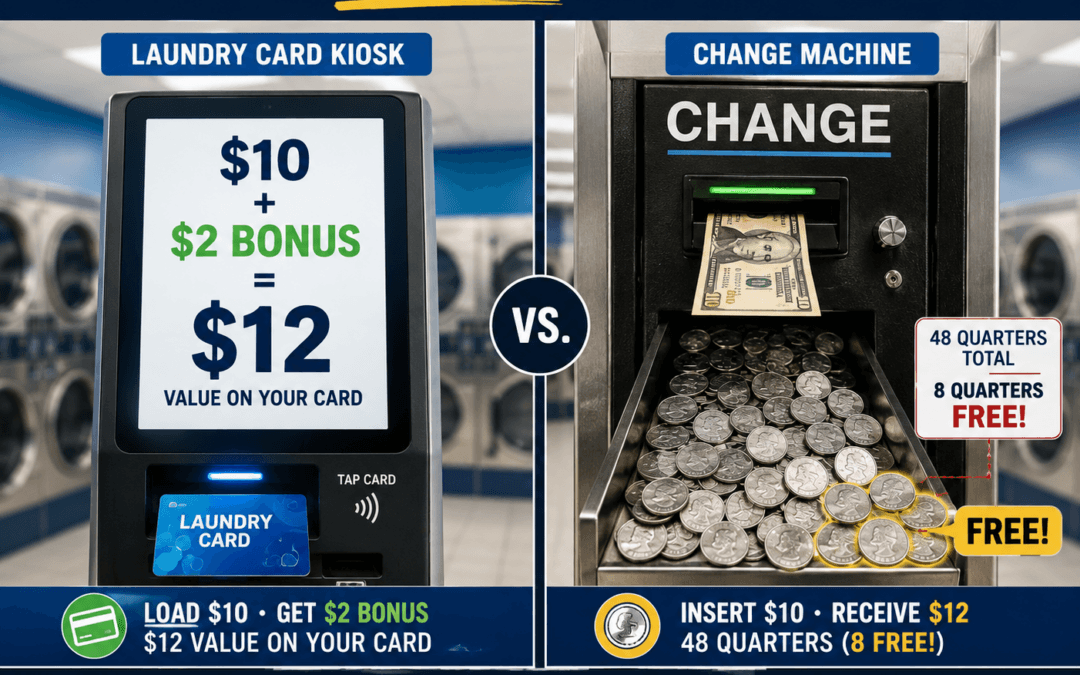
Put $10 on Your Card. We’ll Give You $2 FREE!
Stored-value laundry systems often allow owners to offer incentives for customers who purchase or revalue their cards. Often referred to as “buying loyalty” or providing an incentive to return again and again.
Load $10. Get $2 additional value.
Load $20. Get $2 additional value.
The bonus appears electronically, so it may not feel much like giving away money.
But let’s try the same promotion with a change machine:
INSERT $10 — RECEIVE $12 IN QUARTERS!
Put in a $10 bill and 48 quarters drop into the coin cup.
Eight of those quarters are the bonus.
Suddenly that $2 feels a little more real.
Of course, the two aren’t exactly the same. The eight quarters are real currency and can leave the laundromat. The $2 promotional card balance can only be spent there.
But that doesn’t make the card bonus free.
When the customer spends it, a machine operates. Water, sewer, gas, and electricity are consumed. Equipment accumulates another cycle of wear.
And there’s another question:
Would that customer have purchased the additional $2 of laundry anyway?
If so, the promotion may have discounted revenue the store otherwise could have collected.
Then There’s “FREE DRY”
Free Dry can be a powerful competitive promotion.
But there’s an important distinction:
It’s free to the customer. It isn’t free to the laundromat.
The dryer still consumes gas and electricity. It still turns. Components still wear. It still requires cleaning, maintenance, and eventual repair.
And the dryer isn’t generating direct revenue while providing that service.
That doesn’t necessarily make “Free Dry” a bad promotion.
Perhaps higher washer vend prices cover the expense. Perhaps Free Dry attracts enough additional customers to increase overall store profitability.
Great.
Then it’s a successful marketing investment.
But let’s call it what it is.
If the customer isn’t paying for the dryer, the cost has to be recovered somewhere else.
And Don’t Forget Payment Processing
When customers use debit or credit cards to purchase or revalue stored-value cards, those transactions don’t process themselves.
There can be percentage-based processing charges, per-transaction fees, and other payment-system expenses depending upon the provider and agreement.
Those are recurring costs.
So are stored-value bonuses.
So is Free Dry.
So is collecting quarters.
Put them all on the ledger.
[SIDE NOTE: Please see our recent blog on the reported increasing costs of card processing here.]
The Quarter Has One Interesting Advantage
There’s another way to look at those quarters circulating through a laundromat.
They aren’t necessarily an inefficiency.
They are being reused.
A customer puts $20 into a change machine and receives quarters. Those quarters go into the washers and dryers. The owner collects them and returns an appropriate amount to the changer.
Then they can facilitate another transaction.
And another.
And another.
Once the laundromat owns an adequate inventory of quarters, those same coins can facilitate thousands of transactions without charging the owner a percentage every time they change hands.
The quarter may still require handling.
But the quarter doesn’t send you a processing bill.
Visible Costs vs. Invisible Costs
And maybe that’s the real issue.
An owner sees himself spending Saturday morning collecting quarters.
He feels those hours.
A processing fee quietly comes out of a settlement.
A $2 bonus automatically appears on a customer’s laundry card.
A free dryer turns without putting money into a cashbox.
Automation can make expenses less noticeable.
It doesn’t make them disappear.
We’re not suggesting that quarters are always less expensive.
We’re certainly not suggesting that electronic payment options don’t provide tremendous convenience and useful management capabilities.
We’re suggesting something much simpler:
Do the math.
Calculate what you actually spend collecting and handling quarters.
Then calculate what you actually spend on payment processing, payment-system expenses, promotional stored value and Free Dry. Take a real close look at your credit card processing statement. Consider your monthly fees to the card system for accessing their server and storing your data (Can be as high as $199 to $400 per month).
And determine whether those promotions generate enough additional profitable business to justify their cost.
You may discover that eliminating quarters saves more than you expected.
Or you may discover that you traded a very visible expense for several less-visible ones.
Convenience matters. Technology matters. Owner time matters.