In Brief
An aging currency change machine that goes out of service more than it’s in service is not just an inconvenience — it is a revenue problem. Whether to repair or replace comes down to several factors:
- Cost of repairs
- How often it fails
- Availability of spare parts or service techs
- Estimated Useful Life left
Is your currency change machine worth repairing?
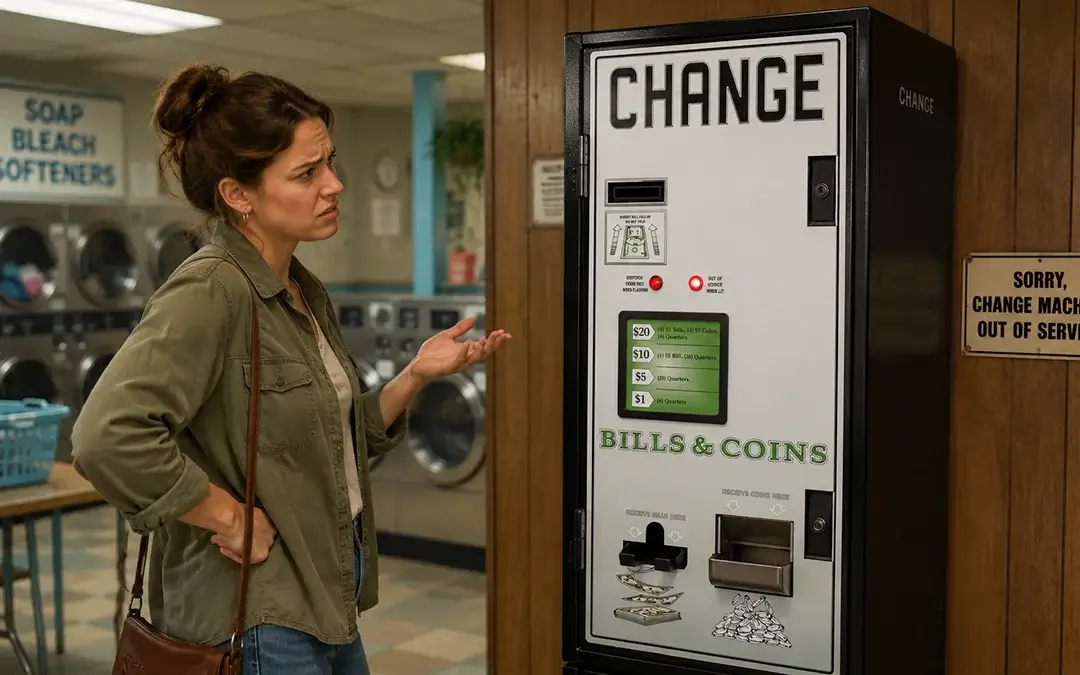
Your currency change machine goes down on a Saturday morning. No attendant on site. Customers walk out. That’s the reality of running an unattended laundromat or car wash — when a machine stops working, the location stops earning.
The question isn’t just whether to fix the machine. It’s whether fixing it still makes sense. This guide covers how to read the signs, run the numbers, and make a decision you won’t second-guess six months later.
Signs your currency change machine needs repair
Not every breakdown is a death sentence for the machine. Most operators have dealt with a spike in bill rejections or coin jams. Those are normal maintenance events.
Bill validator errors are the most common example. When a machine starts turning away good bills, the validator is usually the first place to look — not the entire unit. A dirty or worn validator can be cleaned or swapped out without touching anything else. The machine runs fine afterward.
Maintaining an inventory of spare parts is an essential part of the maintenance program. When your bill acceptor starts rejecting bills and cleaning it doesn’t help, you can install your spare bill acceptor and send the problem unit to a service center. When it comes back, put it on the shelf.
Other signs that point toward repair: intermittent coin-dispensing problems, occasional jam errors with a clear cause, or strange error codes that showed up right after a power surge. If there’s an obvious explanation and the repair is contained, fix it.
Standard Change-Makers Parts Dept. has new and refurbished bill acceptors and hoppers available, as well as spare cables, lock plugs, power supplies, and other components to fix known issues. Contact the Service/Parts Department for price and availability.
It’s important to properly maintain your equipment, keep an inventory of critical components, and understand the signs that something needs to be repaired or replaced – rather than considering removing the entire machine.
Signs it is time to replace your change machine
Some bill changer machines reach a point where the cost of repairs and the frequency of downtime require too much of your time and energy to keep them operational. You’re just managing the problems.
If you’re scheduling service calls on the same unit every few months, that cadence is telling you something. Change machines are built to run hard, day after day, without much fuss. Frequent breakdowns are not normal wear. These are electromechanical devices, and at some point, the change machine will need to be replaced.
Parts availability is the primary factor that can’t be controlled. Older machines eventually age out of the supply chain. Either the manufacturer stops making it or goes out of business. When a technician can’t source a component, your machine waits. In an unattended location, that wait time has a direct cost — and there’s nobody on-site to explain the situation to a frustrated customer.
Look at the full picture. When a major component is obsolete, you are forced to seek a viable direct replacement of that component, or in the worst case, you may have to replace the entire machine.
An example would be Standard’s System 500/600 series bill validators. From the 1980’s to 2017, these were workhorse devices that served the industry well. When the technology became outdated, Standard could no longer secure the control board components. In an effort to offset the cost of replacing an entire machine, they developed the SC-Conversion Kit, which replaces the System 500/600 validator with a CPI validator. This allows the operator to keep their cabinet and working components in place with a manageable investment.
How to weigh repair cost against replacement value
There’s a rule of thumb that holds up across most commercial equipment: if repair costs add up to more than 50% of what a comparable replacement unit would run you, replace it. An aging machine that has been in service for more than 10 years starts to nickel and dime you for replacement parts, is down more than usual, and is unlikely to recoup that investment before something else breaks – it is a candidate for replacement.
It’s a starting point, not a hard ceiling. A machine with one significant failure after years of clean operation is a different case than one that’s been on the service rotation for the past 18 months. Run the numbers, but factor in what you know about the machine’s history. More on repair vs. replace decision frameworks from FTMaintenance.
Transaction volume matters more than years of service! A machine handling 400 cycles a day at a busy location is under more stress than one handling 80 cycles a day. The same repair cost means something different depending on how hard the machine works on a regular basis.
Standard Change-Makers has been building change machines for operators like these since its founding in 1955. Learn more about Standard Change-Makers and the depth of experience that goes into the equipment.
What to look for in a replacement change machine
When the math points toward replacement, buy for the long run. The upfront cost is the easy part. What operators tend to underweight is everything that comes after — service support, parts availability, parts lead times, and how the machine actually performs beyond the first two years of operation (after the warranty expires). Familiarity with the brand and experience working with the support team should also be key considerations.
Now is the perfect time to properly size your new machine for the current needs of your business model. Make sure you have the coin capacity required to meet your collection goals. Consider redundancy in bill acceptance and coin dispensing. There have been technology upgrades since your last machine was put into service. Those upgrades may save you time and effort, and now would be the time to take a closer look at what’s available. For instance, Standard’s new remote access portal, SCM Connect, is a new technology that allows owners to see their machine in real time on a dashboard. It also allows owners to reset a machine remotely and vend coins from the convenience of their cell phone or laptop.
Bill validator quality is worth paying particular attention. A validator that reads cleanly across denominations and doesn’t reject worn bills keeps the machine earning and keeps customers from walking away annoyed. Coin-dispensing consistency matters just as much at locations where the machine is the only change option. Overall design, quality of construction, and security of the cabinet matter – especially in an unattended location.
Working directly with the manufacturer and authorized distributor matters more than operators sometimes realize. You need people who understand the equipment, stock the parts, can troubleshoot problems, and will still be around when you need them. Manufacturer support lines are busy; techs are both repairing components and answering questions over the phone. You want to work with a manufacturer that answers the phone, returns phone calls, and emails in a timely manner.
Browse Standard Change-Makers’ self-service payment solutions to find the right fit for your location.
Frequently asked questions about change machines
How long do change machines last?
It depends on how hard the machine works and how well it’s maintained. A well-built unit in a high-traffic unattended location, serviced consistently, can run reliably for many years. Machines that skip maintenance or sit in rough environments tend to age faster. Build quality at the point of purchase has a bigger effect on service life than most operators expect.
Is it worth repairing an older change machine?
Age alone isn’t necessarily the deciding factor. The 50% Rule gives you a practical floor: if the repair estimate is more than half the replacement cost, you’re usually better off replacing. But the machine’s recent history matters just as much. A machine that’s needed multiple repairs in the past year is likely to keep going that direction.
What are the hidden costs of change machine downtime?
The repair invoice is the visible part. What’s harder to count is the revenue the machine didn’t generate while it was down, and the customers who left and didn’t come back.
At an unattended location, there’s no staff to redirect anyone or explain the situation. The machine either works or customers go somewhere else. See what laundromat downtime costs operators. [Editor: verify URL live; confirm Metrobi qualifies as authoritative source. Replace with trade publication if not.]
What should I look for when buying a replacement change machine?
Start with overall construction quality (cabinet, locks, steel vs. plastic), bill validator reliability, and coin dispensing reliability — those factors determine most of the day-to-day experience. Coin dispensing accuracy matters, especially where customers have no other option.
Then look at manufacturer support: parts availability, service response, and whether the company has a track record of standing behind their equipment over the long haul.
Ready to find the right machine for your location?
Most operators know before they call the technician. When you’re already dreading the next service call on the same unit, the repair vs. replace question has usually answered itself. The numbers — repair cost against replacement value, failure frequency, remaining service life — just confirm what the pattern is already telling you.
A machine built for the demands of self-service businesses performs differently from one that wasn’t. So does the support behind it.
Contact Standard Change-Makers to find the right machine for your location.